 Crockmeter
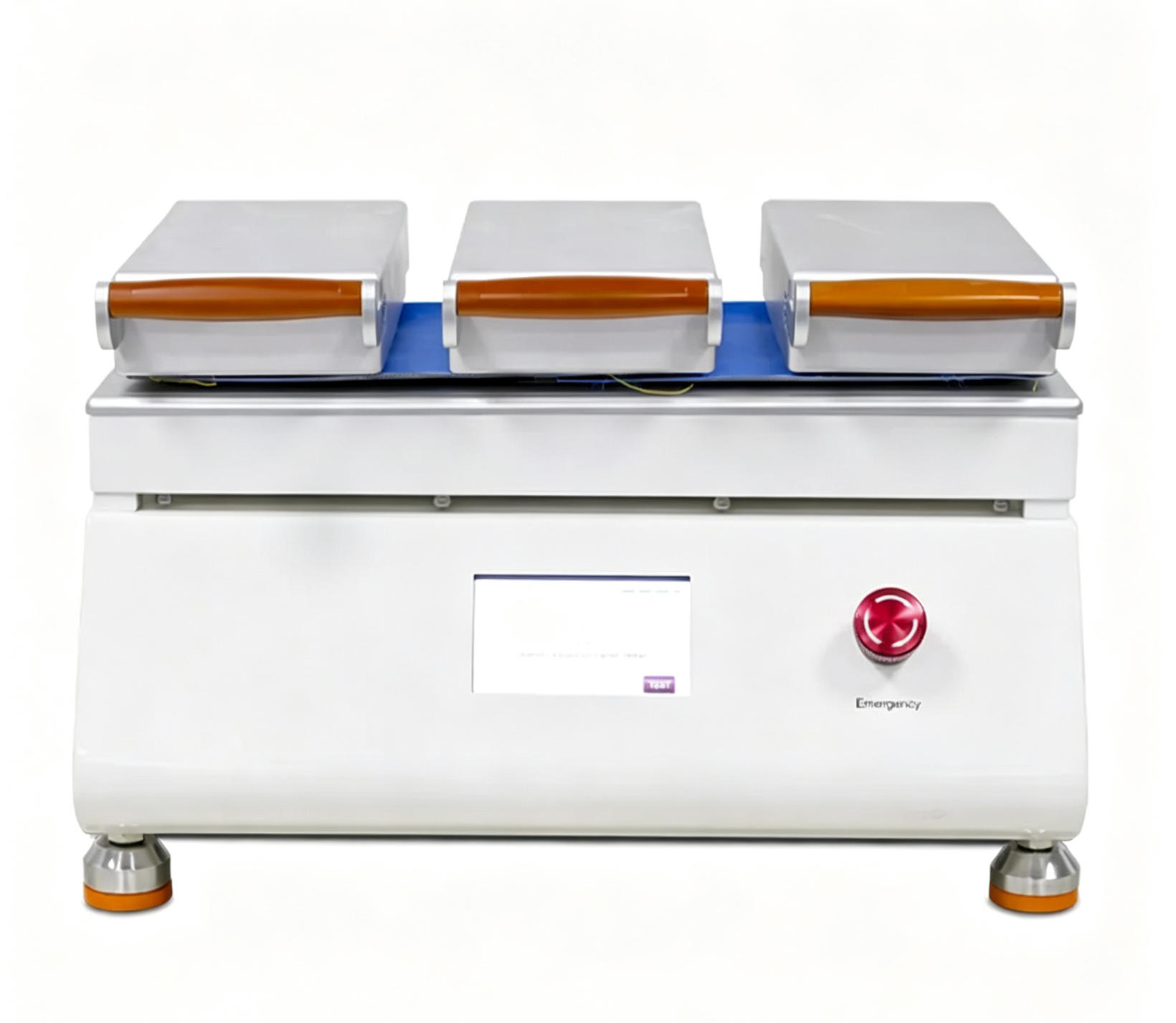
TNG1025
Scorch Tester (Sublimation Fastness Tester) - TNG1025
The TNG1025 Scorch Tester measures color fastness of textiles under high temperature, hot press, and hot drum conditions. It is commonly used for sublimation fastness, chlorine loss, and yellowing tests on various dyed fabrics.
- Specifications
- 15
- Methods
- 3
- Images
- 5
- Supply
- Inquiry only
Inquiry only. No prices are published.
Product overview
The TNG1025 Scorch Tester is designed to evaluate color fastness of textiles under high temperature, hot press, and hot drum processing conditions. It supports testing for sublimation fastness, chlorine loss, and yellowing of bleached cloth. The instrument applies to fabrics dyed with disperse dyes, reactive dyes, and resin-treated materials. It complies with AATCC 92, BS 1006, and ISO 105 standards. The tester features three independent heating stations with adjustable temperature and time settings, allowing simultaneous testing of three different samples. Each station's heating plates are made of aluminum alloy, ensuring good thermal contact with the sample. The adiabatic body around the heating blocks is constructed from PTFE die-casting, providing uniform temperature distribution. The device operates on 220 V, 50 Hz, and has a temperature range from room temperature to 230°C with an accuracy of +/- 2°C. It also maintains a pressure of 4 kPa +/- 1 kPa. The built-in timer allows for heating durations between 0 and 240 seconds, automatically stopping the process and issuing an alarm. The user interface includes an industrial-grade color touch screen for easy operation and control.
Application
This sublimation tester can be used for fabric sublimation color fastness test, chlorine loss (resin finishing fabric)test, bleached cloth yellowing test, disperse dyestuff sublimation color fastness test, reactive dyestuff water ironing fastness test, etc.
There are generally three types of fabric sublimation color fastness tests: dry press test (when the specimen is dry), semi-dry press test (when the specimen is partially wet), and wet press test (when the specimen is completely wet).
Features
Accurate testing: The upper and lower heating blocks are made of aluminum alloy treated by grinding and sandblasting oxidation to ensure good coupling between the heating block and the sample, and the adiabatic body around the heating block is made of PTFE die-casting, which has good adiabatic property and ensures the uniformity of temperature.
Three stations, high efficiency: 3 different kinds of sample testing can be done at one time, and the temperature of the upper and lower heating plates of each station is accurately controlled by independent controllers, and individual temperature and time settings can be made.
Easy to use, long life: industrial grade color touch screen display and control, friendly human-machine interface, solid-state relay control of the heater, no noise on and off, long life.
Technical description
- Large LCD display, convenient setting, and operation.
- 3 pairs of heating plates, the heating temperature of each upper and lower plate can be set individually.
- Timer: 0 ~ 240 s, automatically stops heating and alarms
- Temp. Range: R.T. ~ 230°C
- Temp. Accuracy: +/- 2°C
- Pressure: 4 kPa +/- 1 kPa
- 3 stations with heating plate dimensions 120 mm x 50 mm
- Other voltages require an external transformer
- Length: 460 mm
- Width: 310 mm
- Height: 310 mm
- ISO 105 P01/X11
- AATCC 117/133
- Test Procedure of Sublimation Color Fastness Test
- Before the experiment, the heat-treated or dried specimen material must be humidified (at a relative humidity of 65% ± 5% and a temperature of 21°C ± 2°C). The bottom plate of the heating device is covered by an asbestos sheet, wool facecloth, and dry undyed cotton cloth in order.
- ①Dry pressing: Place the dry specimen on the cotton cloth covered with wool flannel liner, put down the upper plate of the heating device, and heat the specimen for 15s under the specified hot pressing temperature. please note that some standards are the 30s, and set the time in combination with the standard.
- ②Tide pressure: Place the dry specimen on the cotton cloth covered with wool facecloth liner, soak a 12cm×4cm undyed cotton liner in distilled water, squeeze or shake the water to make it contain its own weight of water, and place the wet cotton liner on the dry specimen, put down the upper plate of the heating device, and heat the specimen for 15s or 30s under the specified heat pressure temperature.
Key features
- Large LCD display, convenient setting, and operation.
- 3 pairs of heating plates, the heating temperature of each upper and lower plate can be set individually.
- Timer: 0 ~ 240 s, automatically stops heating and alarms
- Temp. Range: R.T. ~ 230°C
- Temp. Accuracy: +/- 2°C
- Pressure: 4 kPa +/- 1 kPa
- 3 stations with heating plate dimensions 120 mm x 50 mm
Test method notes
GB/T 6152-1997 Tests for colour fastness--Colour fastness to hot pressing ( Sublimation Test Standard) Sublimation fastness definition Sublimation fastness is to determine the color of various types of clothing materials, the ability of high temperature resistance and the color retardant of the clothing material under heat pressure or heat drum process. Methodology Dry pressing: The dry specimen is subjected to a certain time in the pressure device with the specified temperature and the specified pressure. The Gray sample card is used to evaluate the color of the specimen after testing. Tidal pressing: With a wet cotton-lined fabric covered, The dry specimen is subjected to a certain time in the pressure device with the specified temperature and the specified pressure.
Specifications
| Standard Accessories: | Insulation cotton |
|---|---|
| Optional Accessories: | Heat-insulating asbestos sheet |
| DW multi-fiber cloth | AATCC NO.10A multi-fiber cloth |
| 23 kg | — |
| 220 V | 50 Hz |
| Length: 460 mm | Width: 310 mm |
| ISO 105 P01/X11 | AATCC 117/133 |
| Timer | 0 ~ 240 s, automatically stops heating and alarms |
| Temp. Range | R.T. ~ 230°C |
| Temp. Accuracy | +/- 2°C |
| Pressure | 4 kPa +/- 1 kPa |
| Weight | 23 kg |
| Length | 460 mm |
| Width | 310 mm |
| Height | 310 mm |
Test standards supported
Each standard is matched to the instruments that support it.
Related instruments
Why request a quotation from TONNY
Founded in 2012 with a 60-person design and assembly team and worldwide supply. No prices are published and no registration is required to read a specification.
Tell us what you need to test.
Send the test method and the material. We will match the model, attach its specification table and reply with a written quotation - no prices published, no registration.