 DeMattia Flexing Tester
TNG1081
Crumple Flex Tester - TNG1081
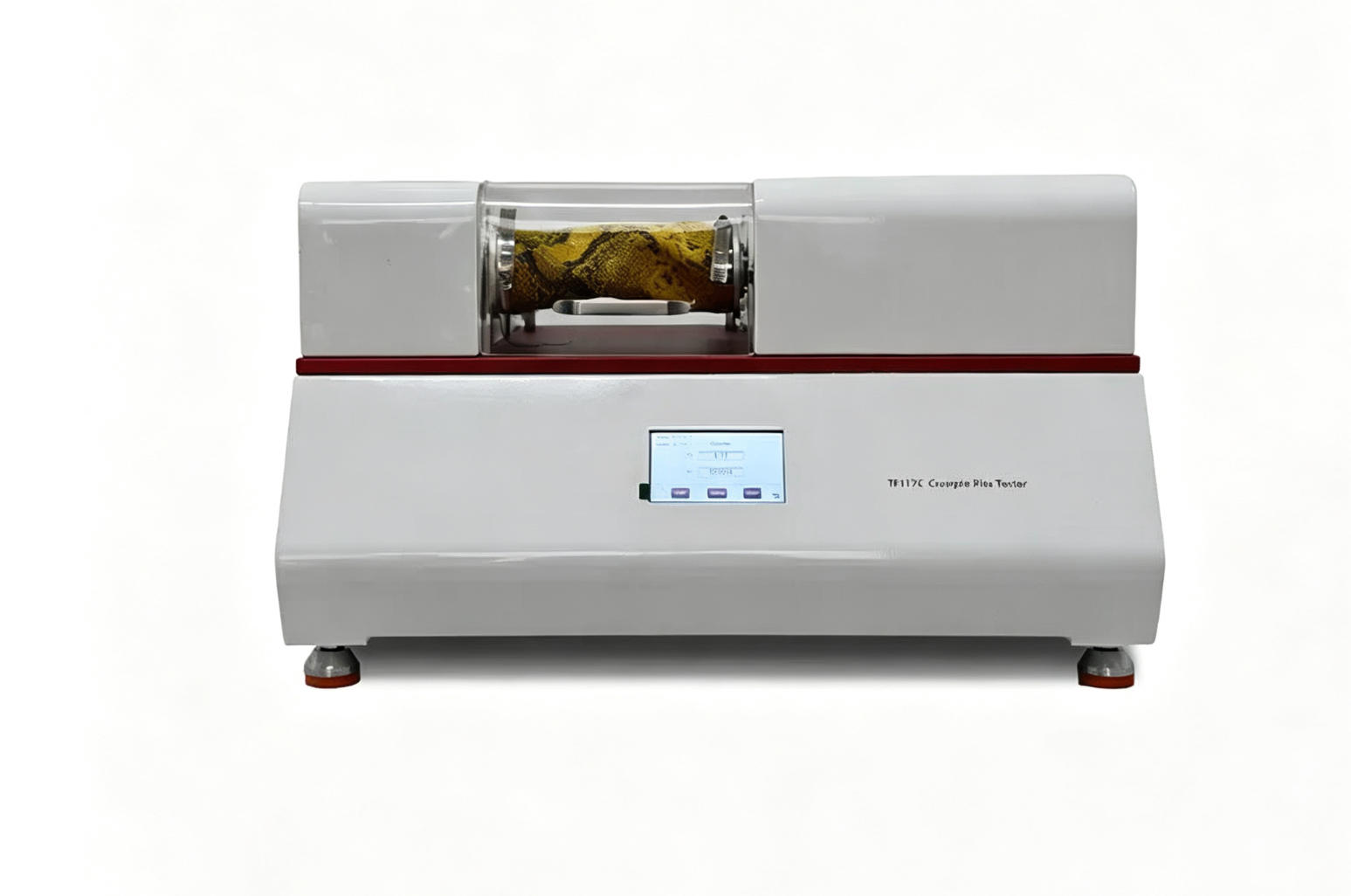
The TNG1081 Crumple Flex Tester measures the degradation of water resistance in coated fabrics caused by repeated flexing and crumpling. It is used to assess the performance of coated textiles under mechanical stress in practical applications.
- Specifications
- 8
- Methods
- 0
- Images
- 5
- Supply
- Inquiry only
Inquiry only. No prices are published.
Product overview
The TNG1081 Crumple Flex Tester is designed to evaluate the water resistance degradation of coated fabrics subjected to flexing and crumpling. The instrument operates by securing a rectangular test sample of coated fabric in a cylindrical shape between two discs. One disc oscillates approximately 90° on its axis, causing the cylindrical sample to twist. Simultaneously, the other disc moves reciprocally along its axis, compressing the sample along its length. This motion simulates the mechanical stress experienced by coated fabrics during use. The test is conducted in accordance with ISO 7854 Method C and GB/T 12586 Method C. The tester is constructed with an acrylic safety cover to ensure operator safety during testing. The dimensions of the instrument are 630 mm in length, 460 mm in width, and 360 mm in height. It is powered by 220 V or 110 V at 50/60 Hz. The TNG1081 is suitable for testing a variety of coated materials, including those used in industrial and consumer applications where water resistance is critical.
Description
Crumple Flex Tester, by using this instrument, the users can test the degradation of water resistance of coated textiles due to flexing and crumpling in daily application use, which contributes to improving the water resistance of the fabric performance for the manufacturers.
Features
- Work stations 2
- Impact design of construction and appearance
- Acrylic safety cover ensures safety in operation
Technical description
- Length: 630 mm
- Width: 460 mm
- Height: 360 mm
- ISO 7854 Method C
- GB/T 12586 Method C
- Test Principle
- Sew a rectangular piece of coated fabric test sample into a cylindrical shape and mounted it between two discs. One of the discs oscillated approximately 90° on its axis. As a result, the cylinder of the coated fabric test piece will twist. At the same time, the other disc moves reciprocally along its axis, thus causing the cylindrical sample to be compressed along its length. This twisting and compression of the cylindrical test specimen continue for a predetermined number of cycles, or until the test piece appears visibly damaged.
- Analysis of flexing damage
- Assess the overall appearance, taking into account all visible factors such as wrinkling, cracking, flaking, and discoloration. Compare the flexed test pieces with the unflexed material and grade the flexed material according to the following four scoring levels. For the unbent material, no magnification is required to observe the damage to the appearance.
- Also, if there is flexing damage (cracking and delamination, etc.), please indicate the type and extent of the damage.
- The experiment report should include the following content.
- 1 Details of the coated fabric markings
- 2 The number of this standard, i.e. GB\T 12586
- 3 The situations the instrument works but its operation fails to follow the standard test procedure
Key features
- Work stations 2
- Impact design of construction and appearance
- Acrylic safety cover ensures safety in operation
Working principle
Sew a rectangular piece of coated fabric test sample into a cylindrical shape and mounted it between two discs. One of the discs oscillated approximately 90° on its axis. As a result, the cylinder of the coated fabric test piece will twist. At the same time, the other disc moves reciprocally along its axis, thus causing the cylindrical sample to be compressed along its length.
Test method notes
What is Flexing Resistance Flexing Resistance is a measure index of bending resistance of rubber, leather, and coated fabric. Take coated fabric as an example, the fabric will be distorted countless times in the process of using and washing, which requires a certain degree of flexing resistance to ensure that the fabric will not be wrinkled or damaged in a certain amount of time. Therefore, folding fastness is an important index of fabric. The fabric is twisted back and forth on a specified test instrument, recording the number of distortions and observing the damage conditions of the coated fabric. CrumpleFlex Test Method Principle: stitch a rectangular coated fabric sample into a cylindrical shape, and fix it between two disks.
Specifications
| 220 /110 V | 50/60 Hz |
|---|---|
| 43 Kg | — |
| Length: 630 mm | Width: 460 mm |
| ISO 7854 Method C | GB/T 12586 Method C |
| Weight | 43 Kg |
| Length | 630 mm |
| Width | 460 mm |
| Height | 360 mm |
Related instruments
DeMattia Flexing Tester
 Schildknecht Flexing Tester
 AATCC Wrinkle Recovery Tester
 Crease Recovery Tester
Why request a quotation from TONNY
Founded in 2012 with a 60-person design and assembly team and worldwide supply. No prices are published and no registration is required to read a specification.
Tell us what you need to test.
Send the test method and the material. We will match the model, attach its specification table and reply with a written quotation - no prices published, no registration.