 Bursting Strength Tester
TNG1016
Knitted Fabric Stretch Recovery Tester - TNG1016
The TNG1016 measures the stretch recovery properties of knitted fabrics. It is used to evaluate how knitted fabrics return to their original shape after being stretched under controlled conditions.
- Specifications
- 12
- Methods
- 1
- Images
- 5
- Supply
- Inquiry only
Inquiry only. No prices are published.
Product overview
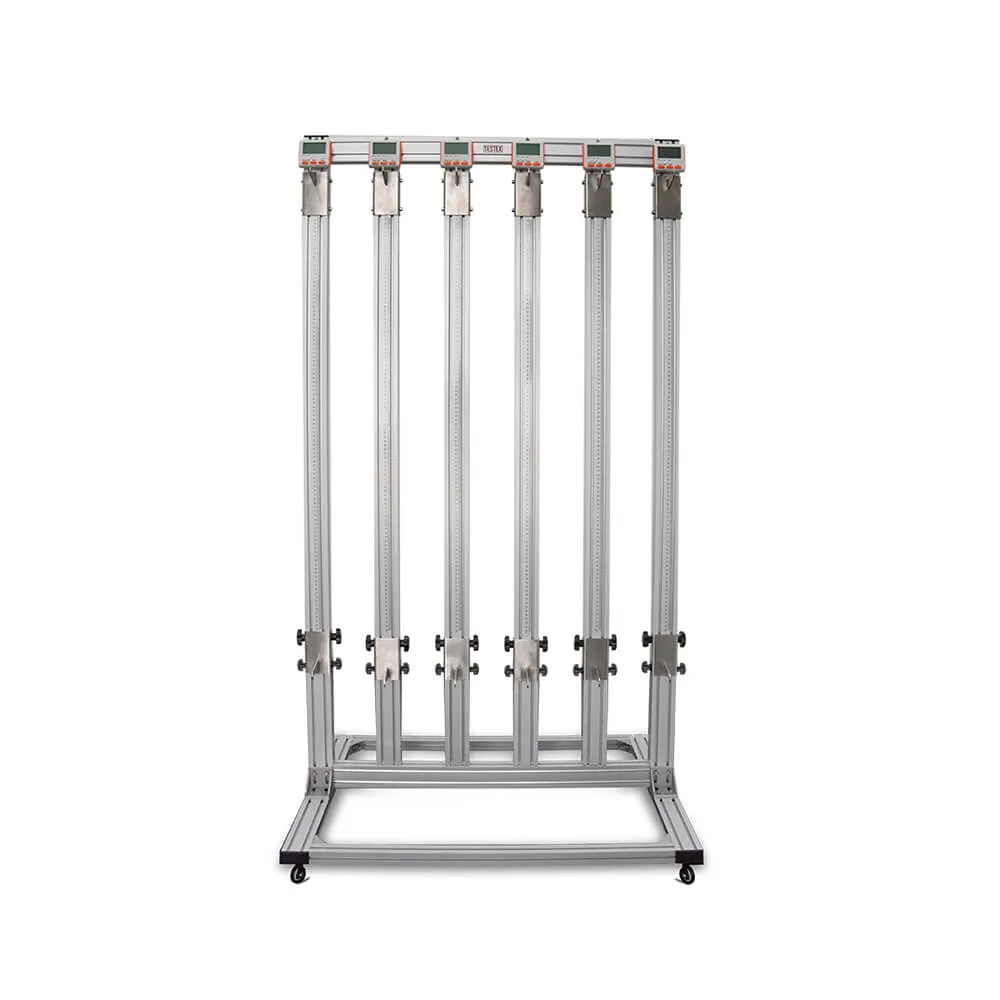
The TNG1016 is designed to assess the stretch recovery characteristics of knitted fabrics according to ASTM D2594. The instrument applies a specified tension to a fabric sample and measures its elongation. It supports both constant load and constant elongation tests, allowing for the calculation of elastic recovery and residual deformation. The TNG1016 is suitable for testing low-stretch knitted fabrics, including materials used in swimwear, sportswear, and other tight-fitting garments. The machine features six test stations, each with upper and lower hangers, and a special elongation scale for accurate measurement. A timer is included at each station for recording test duration. The specimen holder includes quick clamping jaws for efficient sample preparation. The dimensions of the TNG1016 are 1070 mm in length, 440 mm in width, and 1080 mm in height. The test frames are equipped for both constant load and constant elongation testing, providing reliable data for quality control and material development.
Application
The Knitted Fabric Stretch Recovery Tester is suitable for testing the stretch recovery properties of low-stretch knitted fabrics. Examples include low-stretch knitwear such as swimwear, sportswear, and loose or other tight-fitting garments. What’s more, not only this knitted fabric elastic properties testing instrument can perform a constant load test, measuring the elongation of an elastic fabric under a certain tension and calculating the elongation, but also can conduct a constant elongation test, testing the elongation of the fabric to a specified elongation, recording the change in the elongation of the fabric with the tension removed and calculating the elastic recovery and residual deformation.
Test principle
Applying an elastic fabric to a certain amount of tension, the fabric will elongate under the tension. When the fabric elongates to a specified amount of elongation, the fabric will recover with the tension removed.
Features
Both constant load and constant elongation tests in one machine.
Equipped with a special elongation scale for easy marking, measuring, and calculation.
Each station has a timer for easy recording of test time.
Specimen holder with quick clamping jaws for fast and efficient specimen clamping.
Flexible sliding specimen holder with positioning block for fixing anywhere on the guide rail.
The frame, guide rails, and specimen are made of high-quality aluminum, so it has well thickness and strength.
Made of stainless steel, weights, are corrosion-resistant and rust-free.
The feet adopt horizontal adjusting castors, so it is easy to move and install.
Strictly meet standards
All data for the knitted fabric stretch recovery testing machine meet the standard parameters.
Consistency with international third-party laboratories
The test data are comparable to the test results obtained by well-known international third-party laboratories.
Technical description
- Length: 1070 mm
- Width: 440 mm
- Height: 1080 mm
Key features
- Both constant load and constant elongation tests in one machine.
- Equipped with a special elongation scale for easy marking, measuring, and calculation.
- Each station has a timer for easy recording of test time.
- Specimen holder with quick clamping jaws for fast and efficient specimen clamping.
- Flexible sliding specimen holder with positioning block for fixing anywhere on the guide rail.
- The frame, guide rails, and specimen are made of high-quality aluminum, so it has well thickness and strength.
- Made of stainless steel, weights, are corrosion-resistant and rust-free.
- The feet adopt horizontal adjusting castors, so it is easy to move and install.
Working principle
Applying an elastic fabric to a certain amount of tension, the fabric will elongate under the tension. When the fabric elongates to a specified amount of elongation, the fabric will recover with the tension removed.
Test method notes
Stretch Recoverability of Fabric Fabric stretch recovery is calculated as the percentage of the fabric growth recovered with respect to the fabric growth determined after tension or after a specified extension obtained at the various intervals. Fabric with good tensile or elastic properties will shrink itself after spreading and will be difficult to deal with in cutting, sewing, ironing, and other operations. Because of the product drawing, the size changed and the stitching part of the corrugated shape, if the stitching direction of the tension is too large, the sewing is easy to break or shrink the thread. Therefore, when operating for the above-mentioned fabric, we should choose the suitable elastic sutures for tensile properties. Knitted fabric stretch recovery tester, used to determine the tensile properties of the fabric in a certain tension and tensile range.
Specifications
| 50 Kg | — |
|---|---|
| Length: 1070 mm | Width: 440 mm |
| ASTM D2594 | — |
| Test station | 6 |
| Upper hanger | 6 |
| Lower hanger | 6 |
| The width of the hanger | 140 mm |
| Weight | 50 Kg |
| Length | 1070 mm |
| Width | 440 mm |
| Height | 1080 mm |
| Standards | ASTM D2594 |
Test standards supported
Each standard is matched to the instruments that support it.
Related instruments
Why request a quotation from TONNY
Founded in 2012 with a 60-person design and assembly team and worldwide supply. No prices are published and no registration is required to read a specification.
Tell us what you need to test.
Send the test method and the material. We will match the model, attach its specification table and reply with a written quotation - no prices published, no registration.